.webp?Status=Master&sfvrsn=4df45337_2)

.png?Status=Master&sfvrsn=4c04cf13_1)
.png?Status=Master&sfvrsn=d5947d95_1)
.png?Status=Master&sfvrsn=2b1efdd1_1)
Key Takeaways
- French doors need specialized window treatments designed for door applications, not adapted window blinds
- Slim profiles, outside mounts, and hold-down brackets are the three keys to smooth operation
- Common installation mistakes to avoid: inside mounts, bulky styles, and unsecured treatments
- Custom window treatments make the difference, with precise measurements and design choices that ensure smooth operation and a polished look
French doors come with three built-in challenges that standard window treatments aren't designed to handle: limited mounting depth, protruding handles, and constant door movement. Each one creates a different point of failure, and choosing the wrong product means dealing with all three every time you open the door.
Note: If you have sliding glass doors or patio doors rather than French doors, the considerations are different. See our guide to blinds for sliding glass doors for vertical blinds, panel tracks, and other treatments designed for those door types.
Why French Doors Create Window Treatment Challenges
Door Handle Interference
Your door handle is the primary obstacle for most window treatments on French doors. It sits between the glass and the path the blind needs to travel, which creates two-way interference: the handle blocks the blind from operating smoothly, and the blind blocks the handle from being used comfortably. The fix is choosing a treatment with a slim enough profile to slide up and down behind the handle without contact.
1-inch aluminum blinds, Roller Shades, and Cellular Shades typically work well because their headrails and operating mechanisms stay close to the glass. Bulky valances, oversized headrails, and wood or faux wood blinds with slats wider than 2 inches add depth that can hit door handles, walls, or trim during use. As a general rule, the slimmer the profile, the smoother the daily operation.
Movement and Swing Damage
Doors move frequently, and lowered window treatments take the brunt of it. A blind that isn't secured at the bottom can swing into the glass when the door opens or closes, and over time that movement loosens hardware, damages slats, and chips paint or finish.
Hold-down brackets prevent this by anchoring the bottom rail to the door, so the blind moves with the door rather than against it. The brackets are a small piece of hardware, but they're often the difference between a window treatment that holds up over years and one that needs replacing within months.
Best Blinds and Window Shades That Actually Function on French Doors
1" Aluminum Mini Blinds
Aluminum Mini Blinds with 1" slats offer the most practical solution for high-traffic French doors.
Key advantages:
Cold-rolled aluminum construction with a topcoat for maximum strength
Tiltable slats provide flexible light control and privacy adjustment
Cordless lift systems eliminate dangling cords while meeting child safety guidelines
Wipeable surface handles fingerprints and dust easily
Choose aluminum blinds for kitchens, playrooms, and busy entryways where durability matters more than decorative appeal.
2" Wood and Faux Wood Blinds
Wood blinds add warmth and elegance to French doors while maintaining functionality.
Faux wood advantages for specific rooms:
Great for kitchens and bathrooms where moisture is a concern
Designed to resist heat and sun exposure on south-facing doors
Durable and easy to maintain for high-traffic areas
Faux wood blinds resist extreme heat and moisture while requiring minimal maintenance compared to natural wood alternatives.
Cellular Shades
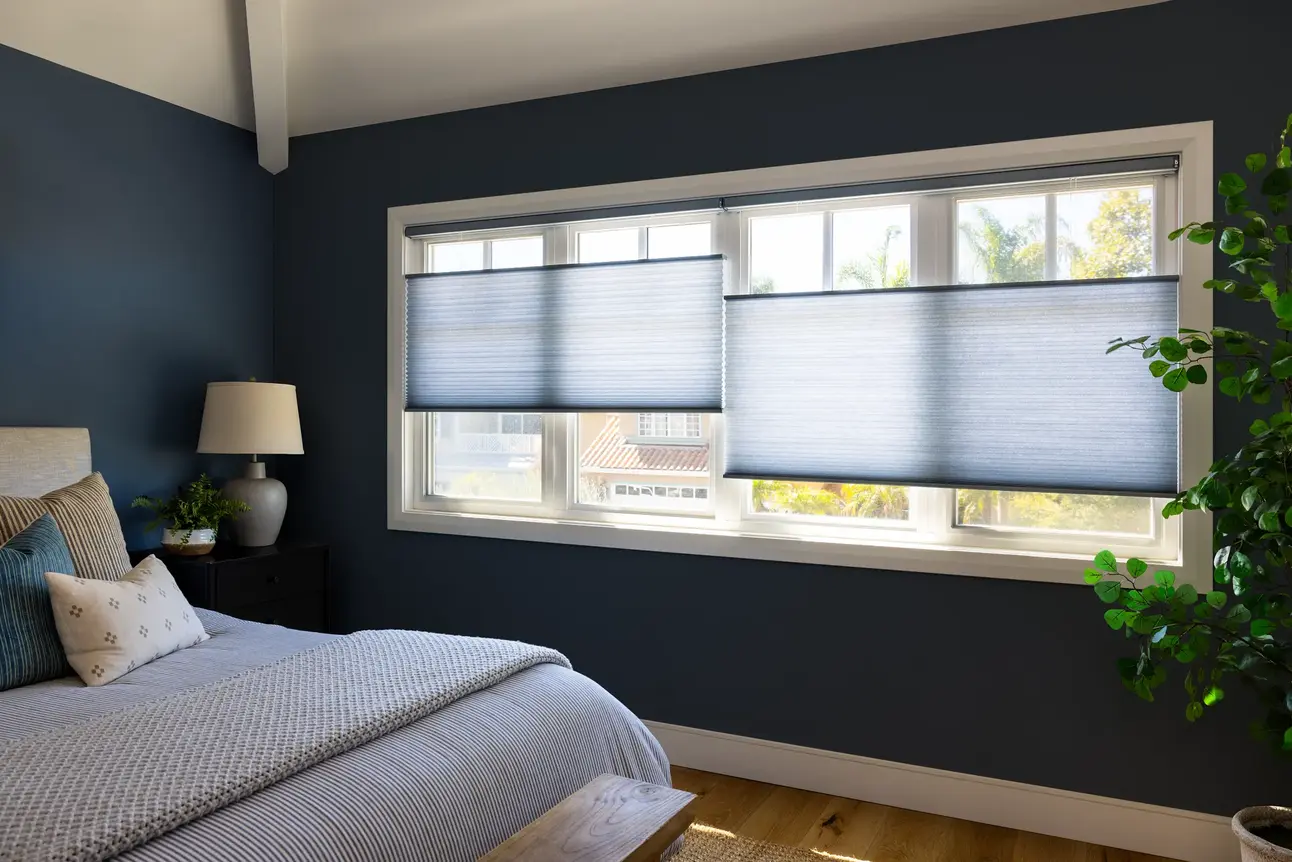
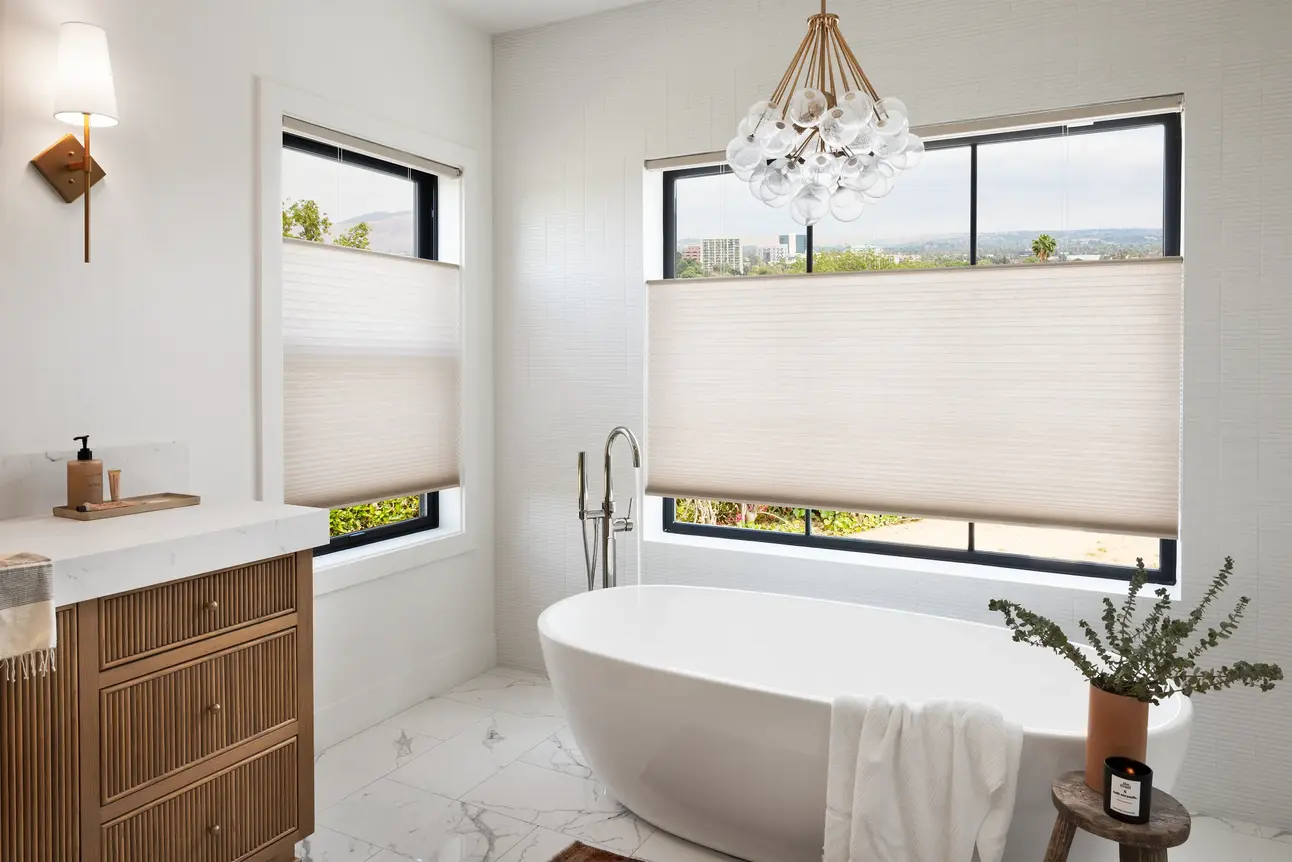
Cellular Shade construction traps air in individual pockets, creating insulation that improves energy efficiency at French doors. Because French doors have large glass surfaces, they're often a weak point for home insulation, and Cellular Shades can meaningfully reduce heat transfer in summer and heat loss in winter. Smaller cell sizes (1/2 inch or 3/8 inch) maintain the slim profile needed for door clearance, while double cell constructions deliver higher R-values when thermal performance is the priority.
Cell size options and applications:
Single cell and double cell options balance clearance needs and insulation performance
Top-down, bottom-up operation for flexible light control and added privacy
Honeycomb cell construction traps air to help insulate your doors, improving energy efficiency and indoor comfort
With a range of fabrics and configurations, Cellular Shades can be tailored to fit both your functional needs and your overall design.
Roller Shades
Roller Shades provide the slimmest profile available for French doors.
Performance benefits:
Smooth operation that moves with the door without snagging
Light-filtering fabrics reduce glare while preserving room brightness
Minimal hardware requirements suit shallow mounting conditions
Roller Shades work particularly well for modern homes where clean lines matter more than decorative elements.
Roman Shades
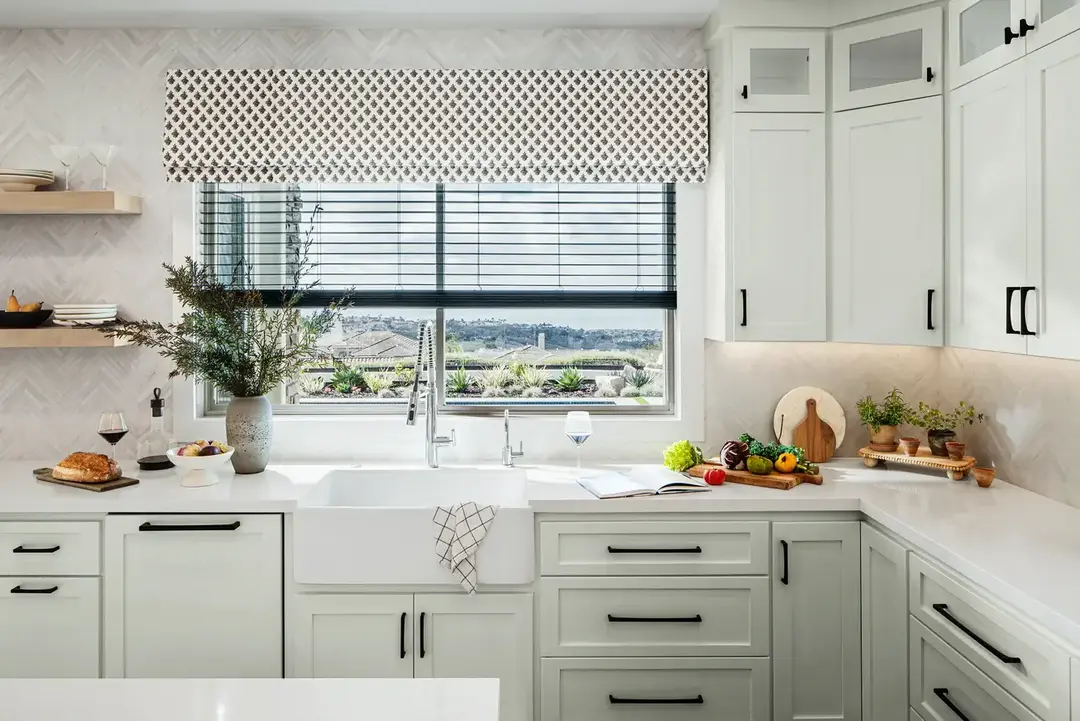
Roman Shades combine the softness of drapery with the functionality of a shade, offering a tailored look that works well on French doors when properly installed.
Fold styles and room applications:
Flat Roman Shades: Clean, modern look that highlights patterns and textures
Soft / Relaxed Roman Shades: Drapery-inspired style with a more casual, flowing appearance
Hobbled (Soft Fold) Shades: Dimensional folds that add depth and a more traditional feel
Light control options:
Light filtering: Soften incoming light while maintaining brightness
Room darkening: Increase privacy and reduce light for bedrooms or media spaces
With access to a wide selection of designer fabrics, colors, and textures, Roman Shades can be customized to match your style while delivering the light control and privacy you need.
Want a softer, more tailored look? Explore our full guide to Roman Shades for French Doors for fold styles, fabric recommendations, and design inspiration.Interior Shutters
Interior Shutters take a different approach to French doors than blinds or shades. Instead of hanging in front of the glass, they mount in a custom-built frame that surrounds the door's glass area, with a cutout designed around the door handle. The result is a built-in look that operates without cords, lift mechanisms, or anything that could swing or tangle during use.
Key advantages for French doors:
- Custom handle cutouts eliminate clearance issues entirely, with no extension brackets needed
- No cords or lift mechanisms means nothing to interfere with door operation
- Tilt rods or hidden tilt options control light and privacy without raising or lowering anything
- Substantial visual presence makes them a permanent design feature that often increases perceived home value
- Material options include real wood for premium aesthetics and faux wood or composite for moisture resistance in kitchens and bathrooms
Interior Shutters work especially well on traditional and transitional homes, on French doors that face the front of the house where curb appeal matters, and in rooms where the treatment becomes part of the architecture rather than a covering hung in front of the window. Because each shutter is custom-built to fit the specific door and handle hardware, the finished look is more integrated than any other option covered above.
Best French Door Window Treatments by Room
| Room Type | Best Choice | Why It Works |
|---|---|---|
| Bedrooms | Cellular Shades (Room Darkening) | Helps improve energy efficiency while reducing light for better sleep |
| Bathrooms | Faux Wood Blinds | Durable and moisture-resistant with easy maintenance |
| Kitchens | 1" Aluminum Mini Blinds | Slim profile with a durable, easy-to-clean surface |
| Living Areas | Roman Shades (light filtering) | Soft, elevated style with flexible light control |
| Home Offices | Roller Shades | Clean, low-profile design that helps reduce glare |
| Front-facing rooms Formal spaces | Interior Shutters | Custom handle cutouts, architectural look, often adds resale value |
The right choice depends on your room, how much light control you need, and your overall design style. Each option is designed to work with French doors while maintaining smooth operation
Motorized and Smart Blinds for French Doors
Motorized window treatments solve some of the most common French door frustrations before they start. With no lift cords or wands hanging near the handle, there's nothing to tangle, snag, or get in the way each time you open the door. For French doors specifically, where every inch of clearance matters, motorization isn't just a convenience upgrade. It's often the cleanest way to keep daily operation seamless.
Why Motorization Works So Well on French Doors
The case for going motorized on French doors comes down to a few practical benefits:
- No cords near the handle - the operating mechanism moves to a remote, app, or wall switch, eliminating the most common point of interference
- Cordless child and pet safety - fewer accessible cords means safer installations in busy households, in line with current child and pet safe window treatment standards set by the WCMA
- Easier reach - tall French doors or doors partially blocked by furniture become effortless to operate
- Synchronized pairs - French doors come in pairs, and motorization lets both shades raise and lower together with a single command, avoiding the mismatched look of one side adjusting before the other
Which Shade Types Motorize Well
Cellular Shades, Roller Shades, and Roman Shades all motorize cleanly and retain the slim profile that makes them work on French doors in the first place. Cellular Shades are especially popular for motorization because their lightweight fabric draws very little battery power, extending time between charges.
Power and Smart Home Options
Most modern Motorized Shades run on rechargeable lithium battery packs that typically last 6 to 12 months between charges, with hardwired and solar-charging options available for higher-traffic doors or sun-facing exposures. Many systems integrate with Amazon Alexa, Google Home, and Apple HomeKit, allowing voice control or scheduled routines. This is useful for raising shades at sunrise, lowering them at sunset, or closing them automatically when you leave the house for added privacy and security.
For French doors that get used multiple times a day, the combination of no dangling hardware and one-touch operation is often the difference between window treatments you fight with and ones that simply disappear into the rhythm of daily life.
Common French Door Blind Mistakes to Avoid
Some window treatment choices seem like they should work on French doors, but often lead to frustration. Avoiding these common mistakes can help you save time, money, and daily hassle.
Inside Mount Installations
Inside mounts are rarely an option for French doors because the glass sits almost flush with the frame, leaving little to no depth for proper installation. Most standard brackets require more space than the door frame can provide.
Trying to mount within the frame instead of directly onto the door can lead to poor support and potential damage. There’s a higher risk of drilling too close to the glass, which can cause cracking or breakage.
For these reasons, outside mount is typically the safer and more effective approach, giving your blinds the clearance they need to function properly without risking damage to the door.
Curtains Without Proper Hardware
Curtains may seem like an easy solution, but without hold-down brackets, they tend to move every time the door opens or closes.
This can lead to fabric swinging, catching on handles, or getting in the way when using the door. Over time, this movement can cause wear and make everyday use frustrating. Securing the bottom is key to making curtains work on doors.
Wide Slat Blinds
Blinds with slats larger than 2 inches add excessive bulk to doors. The added bulk makes it more likely they’ll hit door handles, nearby walls, or furniture when the door is in use.
They’re also heavier, which can put extra strain on door-mounted hardware. For most French doors, slimmer options are a better fit for both function and durability.
Window Film for Glass Doors
Window film for glass doors can offer basic privacy, but it comes with limitations. It can’t be adjusted throughout the day, and once it’s installed, your light control is fixed.
Over time, film can peel, bubble, or fade, especially on glass that isn’t perfectly smooth. It also doesn’t provide the flexibility or control that blinds or shades offer, making it a less versatile long-term solution.
Installation Details That Make French Door Blinds Actually Work
The right installation makes all the difference. Proper placement, clearance, and measurements help your blinds operate smoothly without getting in the way.
Outside Mount Installation
Outside mount is the best option for French doors. It provides better coverage than inside mount and avoids the shallow depth issues that make inside mounts difficult on doors. Most French door stiles (the vertical sections of the door frame surrounding the glass) are typically 4 to 6 inches wide, which gives enough room to position brackets above the glass and along the sides without crowding the handle or hinges. Mount brackets to the door frame itself, never to the glass or glazing.
To minimize light gap along the sides, where outside light can leak between the shade and the door frame, add 2 to 3 inches to the width on each side. Choose a side channel or wraparound bracket option if room darkening is the priority.
Use extension brackets (sometimes called projection brackets or spacer brackets) when a door handle or lock mechanism would otherwise interfere with the headrail. Standard extension brackets typically project 1 to 3 inches off the door surface, with longer projections available for thicker hardware.
Interior Shutters use a different mounting approach. Instead of brackets above the glass, shutters install in a frame that surrounds the door's glass area, with the frame attached to the door itself. Your design consultant measures for the specific frame style and material that fits your doors during the in-home appointment.
Hold Down Brackets
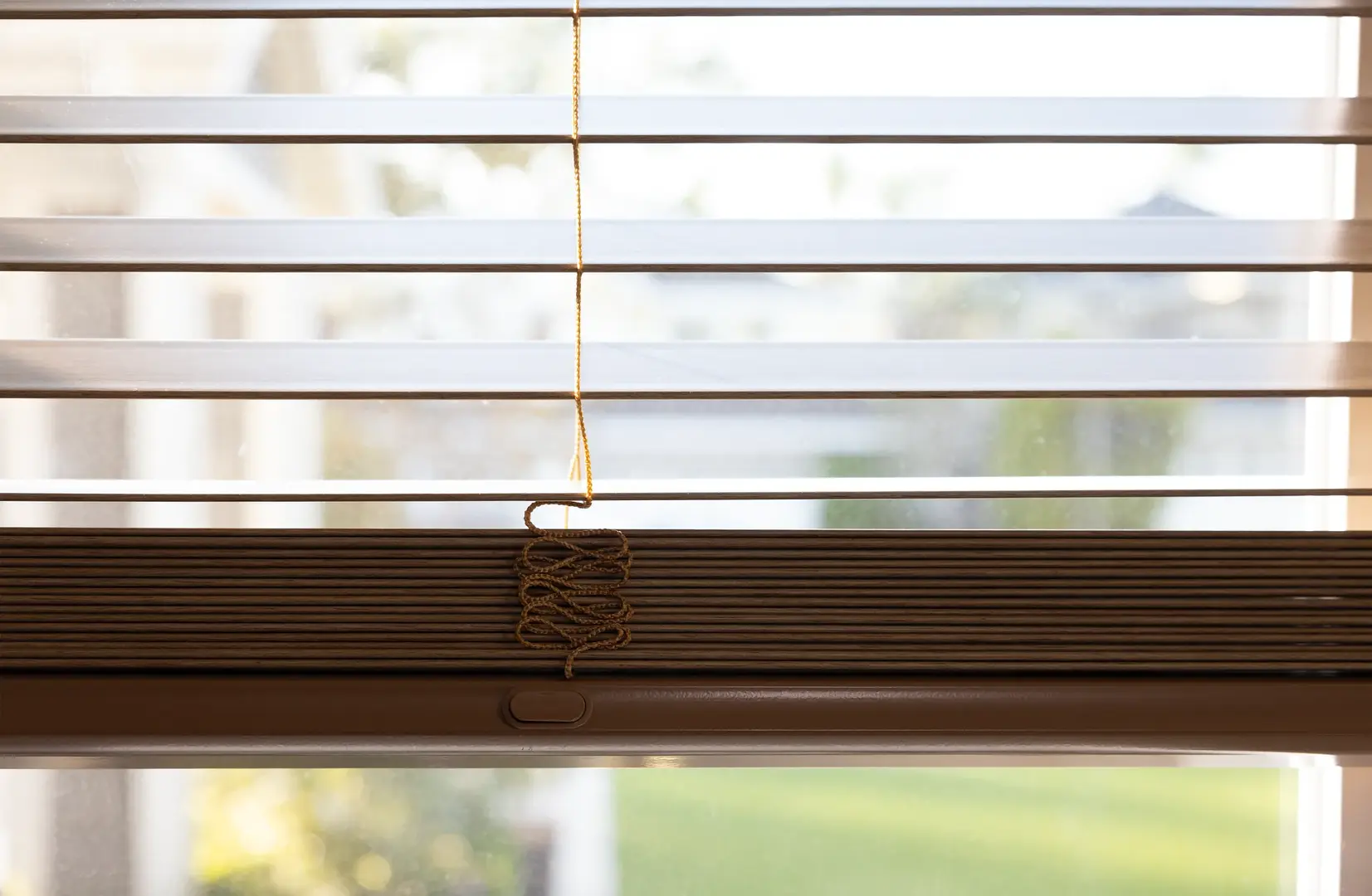
Hold-down brackets attach to the bottom rail of the blind and to the door surface using a small post or hook, securing the blind in place so it doesn't swing when the door moves. 3 Day Blinds includes hold-down brackets with all door-rated treatments, which isn't always standard with off-the-shelf or window-rated alternatives. If you're adapting a treatment originally designed for windows, you'll likely need to source compatible hold-down hardware separately.
Hold-down brackets are recommended for most French door installations, but there are exceptions worth noting. Skip them on lightweight Roller Shades that won't swing significantly under their own weight, on doors that are rarely opened (such as decorative or fixed French doors used primarily for light), and on installations where drilling into the door would compromise weatherstripping. In those cases, your design consultant can recommend alternative stabilization options based on your specific door and shade combination.
Professional Measurement and Fit
French door measurements have less margin for error than standard window measurements. Stile width, handle and hinge clearance, light gap, and door swing direction all need to be accounted for, and a small miscalculation can mean a blind that hits the handle, leaves visible side gaps, or doesn't sit flush against the door.
A 3 Day Blinds design consultant takes all measurements during your in-home appointment, accounting for the specifics of your door, hardware, and how you use the space. Every measurement is taken in context, so the finished product fits cleanly the first time. If something isn't right, the fit is backed by our limited lifetime warranty.
What Your Installer Will Confirm
Even well-planned French door installations have predictable failure points, which is why professional installation matters. Your 3 Day Blinds installer accounts for each of these during setup, so you don't end up dealing with them later.
Headrail clearance against the handle. If brackets are mounted too low, the headrail hits the handle when the blind is raised. Installers verify clearance during mounting and adjust bracket placement to prevent contact at full lift.
Hold-down bracket attachment depth. Door materials vary in density, and standard hold-down screws are sized for an average. On hollow-core doors or thicker stiles, installers switch to longer screws or use anchors so the bracket stays secure over years of door use.
Bottom rail stability on wider blinds. A single hold-down bracket may not be enough on wider French door blinds, especially on doors that get slammed shut frequently. Installers add a second bracket near each end of the bottom rail when needed for full stability.
Interior Shutter installations. If you choose Interior Shutters, the installer focuses on different details: ensuring the frame is square to the door, the handle cutout aligns precisely with the hardware, and the panels open and close cleanly without contacting the door frame or trim.
What to Consider for Your French Door Blinds
A 3 Day Blinds design consultant will walk you through every decision involved in choosing the right window treatments for your French doors. Coming to the appointment with a few preferences in mind helps the conversation move faster and ensures the recommendations match how you actually use the space.
Door Direction and Daily Use
How your French doors open affects which products and installation approaches work best.
- In-swing doors open into the room, requiring enough swing clearance for blinds to operate without contacting nearby furniture, walls, or floor
- Out-swing doors open outward, which simplifies interior planning since the door swing happens outside the room
Take note of how often the doors are used during a typical day. Frequently used doors benefit most from durable products like Aluminum Mini Blinds or Faux Wood Blinds, or from motorized options that eliminate cords near the handle. Doors that are rarely opened give you more flexibility in product choice.
Privacy and Light Control Throughout the Day
Walk through each room with French doors and notice how the light changes from morning to evening, and how visible the room is from outside.
- Bedrooms and street-facing doors typically benefit from room-darkening fabrics
- Living areas and home offices often work best with light-filtering options that maintain privacy without blocking natural light
- South- and west-facing doors may need additional consideration for heat and UV control
Your design consultant will help match specific products to these conditions during the appointment.
Style Preferences and Room Aesthetic
Think about whether you want the window treatments to blend in or stand out. Roman Shades and Wood Blinds add visual warmth and tend to become a design feature. Roller Shades and Aluminum Mini Blinds offer cleaner, more minimal looks that recede into the background. Cellular Shades sit between the two, with fabric variety that can lean either direction depending on the choice. Interior Shutters are the most architectural option, becoming part of the door itself rather than a treatment hung in front of it.
Bringing inspiration photos, paint chips, or fabric samples to your appointment helps the design consultant recommend products that complement the rest of the room.
Budget and Long-Term Value
3 Day Blinds offers products across a range of price points, and the right choice depends on how the space is used and how long you plan to stay in the home. Frequently used doors generally justify higher-quality, longer-lasting products. Doors used primarily for light or decoration can be styled with more flexibility.
Your design consultant can walk through pricing options during the appointment and recommend products that fit both your aesthetic and your budget.
Conclusion
French doors deserve window treatments designed for the way they actually work. Slim profiles to clear the handle, outside mounts to fit the shallow frame, hold-down brackets to keep everything stable, and precise measurements that account for stile width, light gap, and door swing. Get those four right, and the difference is immediate.
Schedule a free in-home consultation with 3 Day Blinds to get personalized recommendations for your French doors. A design consultant will bring samples, take all measurements, and walk you through the products that fit your style, budget, and daily use, all in one appointment.

.png?Status=Master&sfvrsn=837b23bd_1)
.png?Status=Master&sfvrsn=f55daebb_1)