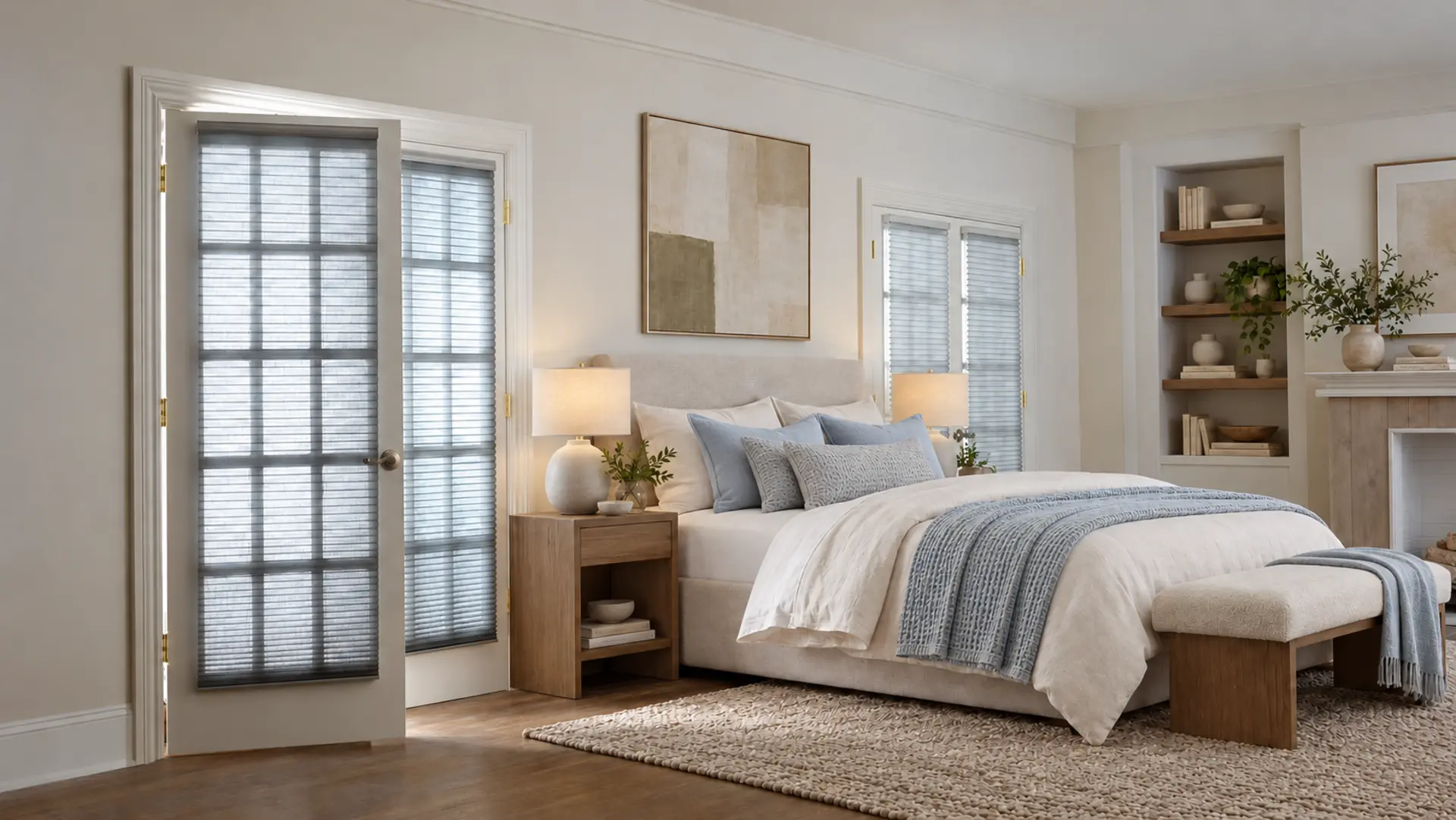



Cellular Shades for French doors solve two problems at once: clearing the door handle, and insulating a panel that is mostly glass. That pairing is newer than it sounds. Nothing in the category used to be shallow enough to sit flat against the panes without catching the handle every time someone walked through. Cellular Shades, also sold as Honeycomb Shades, now come in Single-Cell and Mini Cell constructions built for exactly that clearance, and the same cells that keep them thin are what trap air against the panes.
Key Takeaways
Single-Cell and Mini Cell constructions are shallow enough to clear a French door handle, which is the constraint that rules out bulkier window coverings.
Honeycomb Shades save up to 20% on heating energy and up to 15% on total heating and cooling energy, according to the U.S. Department of Energy.
The cells that keep the profile thin are the same ones that insulate, so fit and performance are not a tradeoff here.
Fabrics run light filtering to room-darkening and come in a wide variety of colors, plus Cellular DuoShade, which pairs two fabrics in one shade.
Cordless is the standard lift on a door, since cords are a snag risk on a swinging panel. Motorized and Top Down Bottom Up are both available.
Hold-down brackets anchor the bottom rail so the shade travels with the door instead of swinging loose.
Will Cellular Shades Fit a French Door Without Hitting the Handle?
Yes, Cellular Shades fit French doors without hitting the handle, as long as the headrail depth is matched to your handle clearance before you order. Depth is the constraint that rules out most other window treatments on a hinged door. There is very little room between the panes and the handle, the panel swings within inches of whatever is mounted to it, and bulky headrails or wide slats clip the hardware or catch the frame on every pass.
Honeycomb fabric folds flat, which is the whole reason Cellular Shades work here. Single-Cell constructions compress to a shallow stack when raised, and Mini Cell goes shallower still, using a tighter, smaller-scale honeycomb built for the tightest clearances. Mini Cell is worth asking about by name on a French door, since it gets far less attention than Single-Cell and Double-Cell but is the construction best suited to a door.
Handle clearance is the first thing I measure in a French door consultation, before we talk about fabrics or colors, because it decides everything that follows. On most of the doors I see, there is less than an inch between the glass stop and the back of the handle. I carry Mini Cell samples for that reason. When a homeowner has a heavy lever handle, Mini Cell is often the only construction that clears it, and almost nobody asks for it by name because it gets so little shelf space next to Single-Cell and Double-Cell.

How Do You Measure and Mount Cellular Shades on a French Door?
Cellular Shades mount to the door panel itself rather than to the wall above it, using an outside-mount bracket or a frame-mount kit made for French doors. Mounting to the panel is what lets the shade travel with the door as one unit instead of hanging separately and swinging free.
Measure handle clearance first. Take the distance from the outer edge of the pane to the point where the handle sits proudest, then I compare it against the headrail depth listed in the product specs. That one number decides which cell construction your door can take.
For the shade itself, measure width and height at three points, at the top, middle, and bottom of the opening. For an outside mount, which is the more common choice on a French door, measure the full area you want covered and add a couple of inches of overlap on each side to close light gaps.
A door also needs hold-down brackets, which a window does not. They anchor the bottom rail so the shade stays flat against the panel through every open and close instead of flapping loose.
The measurement that surprises people most is that I measure each door of a pair separately, they are almost never identical. A quarter inch of difference between two panels is normal, particularly in older homes where the frames have settled, and it is enough to make one shade short while its twin runs fine. I have never regretted measuring both.
I confirm handle clearance, mount type, and bracket placement on-site in a single visit, before anything is ordered.
How Much Do Honeycomb Shades Insulate a French Door?
Honeycomb Shades save up to 20% on heating energy and up to 15% on total heating and cooling energy compared with an uncovered window, according to a U.S. Department of Energy fact sheet on interior cellular shades. Those savings matter more on a French door than on a standard window for a simple reason: a French door is mostly glass, and glass gains and loses heat far faster than a wall does.
The mechanism is straightforward. Each cell traps a pocket of still air between the pane and the room, and still air is a great insulator of heat. Our Double Cell vs Single Cell Cellular Shades guide covers the full construction tradeoff, and Energy Efficient Window Treatments covers how this fits a whole-home approach.
The short version for a French door: Double-Cell insulates the most and sits the deepest, Single-Cell gives up a little performance for a shallower stack, and Mini Cell prioritizes clearance above both. On a swinging panel, clearance usually decides it, which is why Single-Cell and Mini Cell are the common picks even though Double-Cell would insulate better.
Do You Need Light Filtering Cellular Shades or Room Darkening on a French Door?
Light filtering Cellular Shades and blackout Cellular Shades are both available for French doors, so the room decides. Light filtering is the common pick, while blackout comes in the same shallow constructions, which means choosing it does not cost you handle clearance.
Light filtering suits the rooms these doors usually open onto, living rooms, dining rooms, and sunrooms, where the goal is softening glare rather than killing light. It diffuses sun and gives privacy without the cave effect. It also comes in the widest variety of colors and textures.
Room-darkening is what to ask about for a bedroom, a nursery, or a media room. They block nearly all incoming light.
Cellular DuoShade combines two fabrics in one shade, which suits a door you want light through during the day and fully covered at night without swapping window coverings.
This is the correction I make most often on a French door consultation. Homeowners tell me they had ruled Cellular Shades out for a bedroom door because they assumed the fabric only filters light, and they had already started pricing something else. Room-darkening cellular exists, it comes in the same shallow constructions, and choosing it does not cost the clearance that made the product work on that door in the first place.
Cordless, Motorized, or Top Down Bottom Up on a French Door?
Cordless is the standard on a French door and close to a requirement. A dangling cord on a swinging panel is a snag every time the door moves, and cordless is the safer choice in homes with kids or pets. Cordless shades raise and lower with a light push or pull on the bottom rail.
Motorized is worth the upgrade on a door you operate constantly, or one you would rather not touch at all. Remote, voice, and smartphone control are all available.
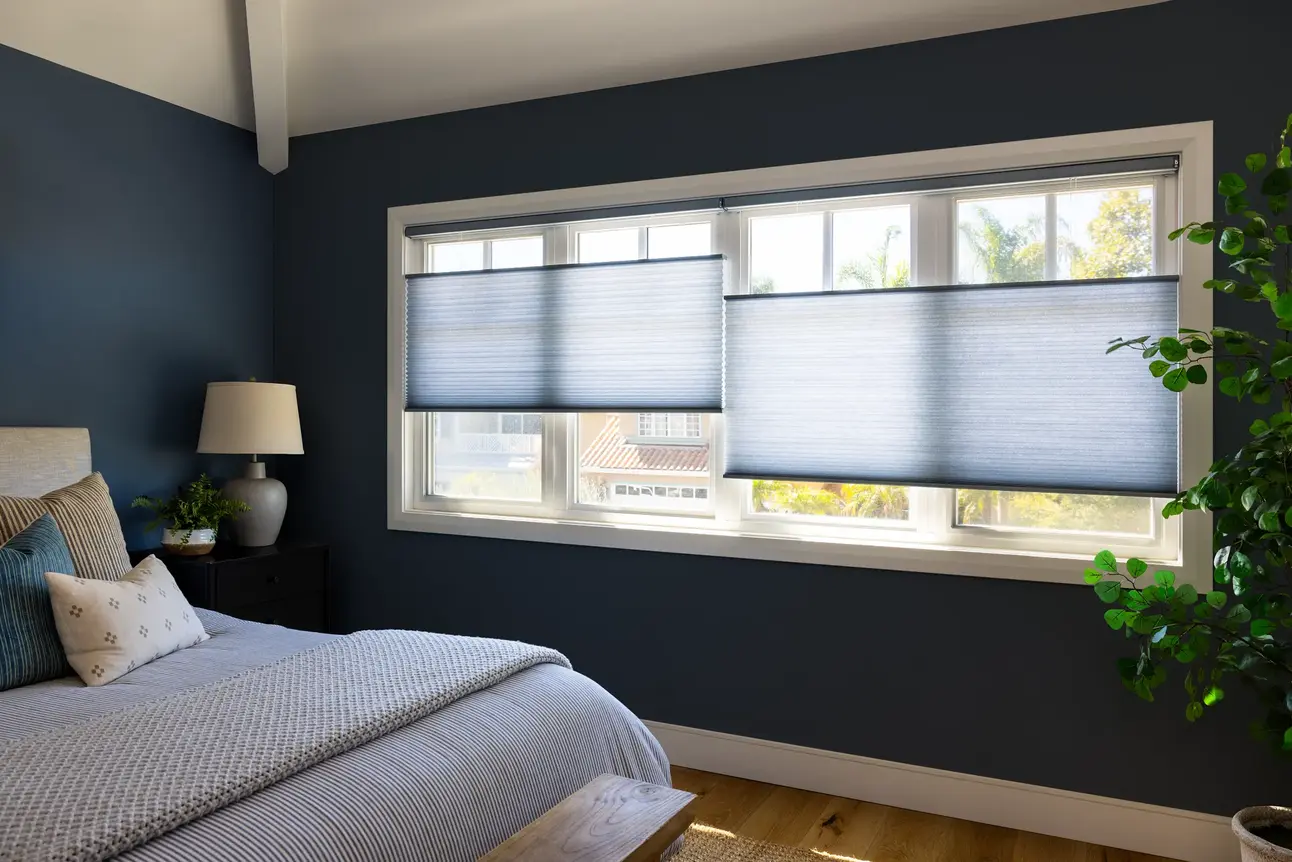
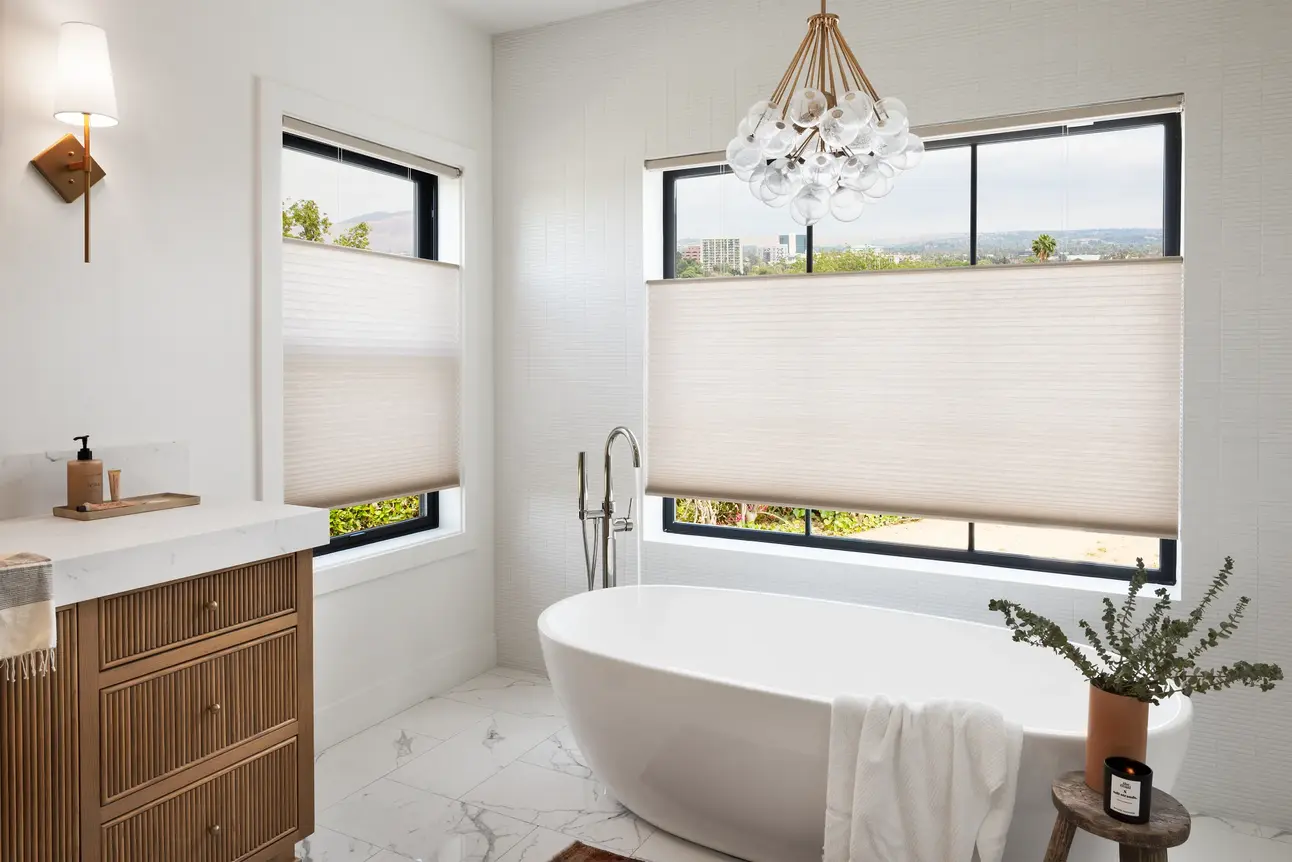
Top Down Bottom Up is the third option and an underrated one. It drops the top of the shade for light while keeping the lower panes covered, which helps on a door facing a walkway or a neighboring yard. Our Top Down Bottom Up guide covers how it works.
What Are the Downsides of Cellular Shades on French Doors?
There are three things to weigh before putting Cellular Shades on a French door, and each one has an answer.
The raised shade covers part of the glass. A Cellular Shade stacks into a band across the top of the opening rather than clearing it entirely, so a French door prized for its view gives up a few inches of it. Mini Cell stacks the smallest, which is the fix when the view is the reason you bought the door in the first place.
When a homeowner tells me they do not want to give up any glass at all, I hand them the sample and ask them to hold it flat against the top of the door. Seeing the stack in position settles the question in about ten seconds, and it goes both ways. Some people decide it is less than they feared. Others decide the view matters more than the insulation, and we look at a different treatment. Either way it is a better conversation than one held over a spec sheet.
A pair of doors needs a pair of shades. French doors hang as a pair and each panel swings independently, so each one needs its own shade and its own hold-down brackets. Budget for two, and measure each panel separately, since a pair is not always perfectly matched.
The pleats hold dust. The structure that insulates is also the structure that catches dust, and clearing every cell with a vacuum brush attachment takes more effort than wiping down a flat slat. Our Are Cellular Shades Worth It guide covers maintenance in full, along with the drawbacks that apply in any room.
One thing this does rule out: consistently damp rooms. Fabric shades do not hold up to sustained moisture, so a French door onto a covered patio is fine, but one in a bathroom or off an indoor pool room is a case for a Faux Wood Blind or a shutter instead.
French Door Blinds vs. Shades: How Cellular, Roller, and Mini Compare
There's no single best answer here. It depends on what you're optimizing for.
| Feature | Cellular Shades | Roller Shades | Mini Blinds |
|---|---|---|---|
| Profile | Shallow enough to clear a door handle | Flattest single-layer profile | Slats plus a tilt mechanism |
| Insulation | Highest, trapped air in every cell | Minimal | Minimal |
| Light Control | Light-filtering, room-darkening, or sheer | Light-filtering or room-darkening | Adjustable by tilting slats |
| Cleaning | Pleats hold dust, more upkeep | Easiest to wipe clean | Easy to wipe, shows fingerprints |
| Cordless Lift | Standard | Standard | Standard |
| Best Suited For | Energy efficiency and tight door clearance | Minimal look, easy upkeep | Simple, adjustable light |
This comparison highlights common differences between Cellular Shades, Roller Shades, and Mini Blinds for French doors, including profile, insulation, light control, cleaning, and ideal use.
Flatness and clearance are not the same thing. A Roller Shade rolls to a slim cylinder, but on a French door the question is whether the mounted assembly clears the hardware and the frame. Cellular Shades clear it while also insulating.
Mini Blinds are simple and quick to adjust with a tilt of the slats. They do not insulate the way honeycomb fabric does, and they show dust and fingerprints on a door people touch every day. Wood blinds and faux wood blinds have the same limitation with more weight, which is why they are a better answer for a window than for a panel that swings.
Roller Shades give the most minimal look and the easiest cleaning, with no pleats for dust to settle into. If a clean flat panel is the priority and heat transfer is not a concern, they are a reasonable call.
Custom Cellular Shades are the pick when the room's comfort or energy bills matter, which on a mostly-glazed panel is often.
If you are weighing categories rather than products, though, this is the wrong comparison to be running. Shutters, drapery, and curtains solve the problem differently than any shade does, and our Blinds for French Doors buying guide puts all six options side by side before you narrow to one.
Ready to See Fabrics and Colors on Your French Doors?
A design consultant can check handle clearance, recommend Single-Cell, Double-Cell, or Mini Cell construction for your specific door, and measure for hold-down brackets on the spot, all before you commit to an order. Schedule your FREE In-Home Design Consultation online, or call (833) 721-2528.
More French Door and Glass Door Window Treatments
Shopping for a sliding or patio door instead? Those stack differently, and the window treatments for sliding glass doors guide covers the mounting and stacking logic.
Weighing cell types more broadly: Double Cell vs Single Cell Cellular Shades.